
Description
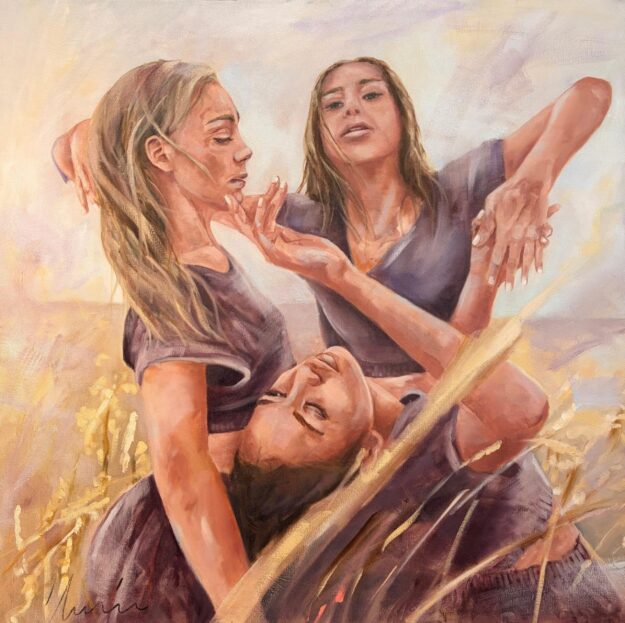
Echoes of Grace emerges as a quiet meditation on memory, where colour and form seem to linger like half remembered dreams. Chenée places us in an amber lit field, yet the true landscape is interior, a terrain of self recognition where past, present, and the self still unfolding come close enough to touch. Three incarnations of one figure inhabit the canvas, not as literal duplicates, but as echoes, each carrying a different temperature of emotion. The work feels suspended, as if time has loosened its grip, allowing the viewer to witness the private choreography of acceptance.
Colour is the first tenderness offered. Warm ochres, sun washed golds, and soft blush tones create an atmosphere that reads like late afternoon light, that fleeting hour when the world looks kinder and you can almost believe in second chances. Against these luminous grounds, Chenée introduces muted purples and smoky violets in the dancer’s clothing, a choice that deepens the emotional register. The purple tones bring gravity, suggesting introspection, the weight of what has been carried, while the surrounding warmth holds it gently, refusing to let it collapse into sadness. This harmony between warmth and shadow becomes the painting’s emotional pulse, grief and grace, doubt and dignity, braided together rather than forced apart.
Chenée’s technique supports this psychological layering with remarkable sensitivity. The background is built in thin, airy veils, allowing the texture of the linen to remain present, which gives the light a natural softness. You can sense the artist’s restraint in the way edges dissolve and reappear, as though the figures are partly remembered, partly real. In the faces and hands, detail gathers with greater focus. Fingertips are shaped with care, wrists articulate subtle tension, and the tilt of a chin becomes a sentence in itself. These choices direct the eye to gesture, because this is where the story lives. The dance is not about performance; it is about communion with the self.
Compositionally, the figures form a close, spiralling arrangement that draws the viewer inward. One profile turns away in contemplative calm, another meets us with a steadier, more declarative presence, while a third reclines in an arc of surrender, head tilted back as if trusting the air to hold her. Chenée uses overlapping arms and diagonals to create a sense of movement without blur, a still image that nevertheless breathes. A golden stalk of grass cuts through the foreground like a quiet line of music, guiding the gaze and reminding us that this encounter takes place within the natural world, where growth is seasonal, cyclical, and often unseen until suddenly it is undeniable.
There is an intimacy here that speaks to cross generational truths, the way we are shaped by who we were, even as we reach for who we might yet become. Many people know this sensation, meeting themselves in fragments, in old photographs, in remembered voices, in the private critic, in the brave inner child. Echoes of Grace does not dramatise that meeting; it dignifies it. The painting suggests that acceptance is not passive resignation, but an active, graceful turning toward what is true.
Chenée’s understanding of movement is palpable, even in stillness. The arms hold the air as though it has weight, and the transitions between figures feel like a sequence of steps, each one necessary. In this way, the work becomes a visual prayer, not loud, not perfect, but honest, offering the viewer permission to soften into their own becoming.
As you stand before Echoes of Grace, which version of yourself steps forward first, and what might happen if you let them dance together without judgement?







Reviews
There are no reviews yet.