Description
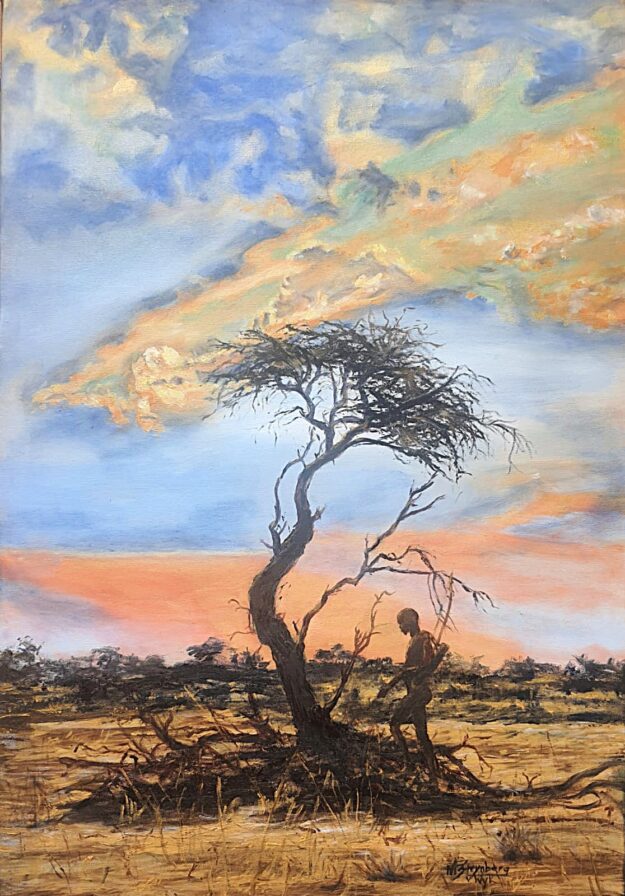
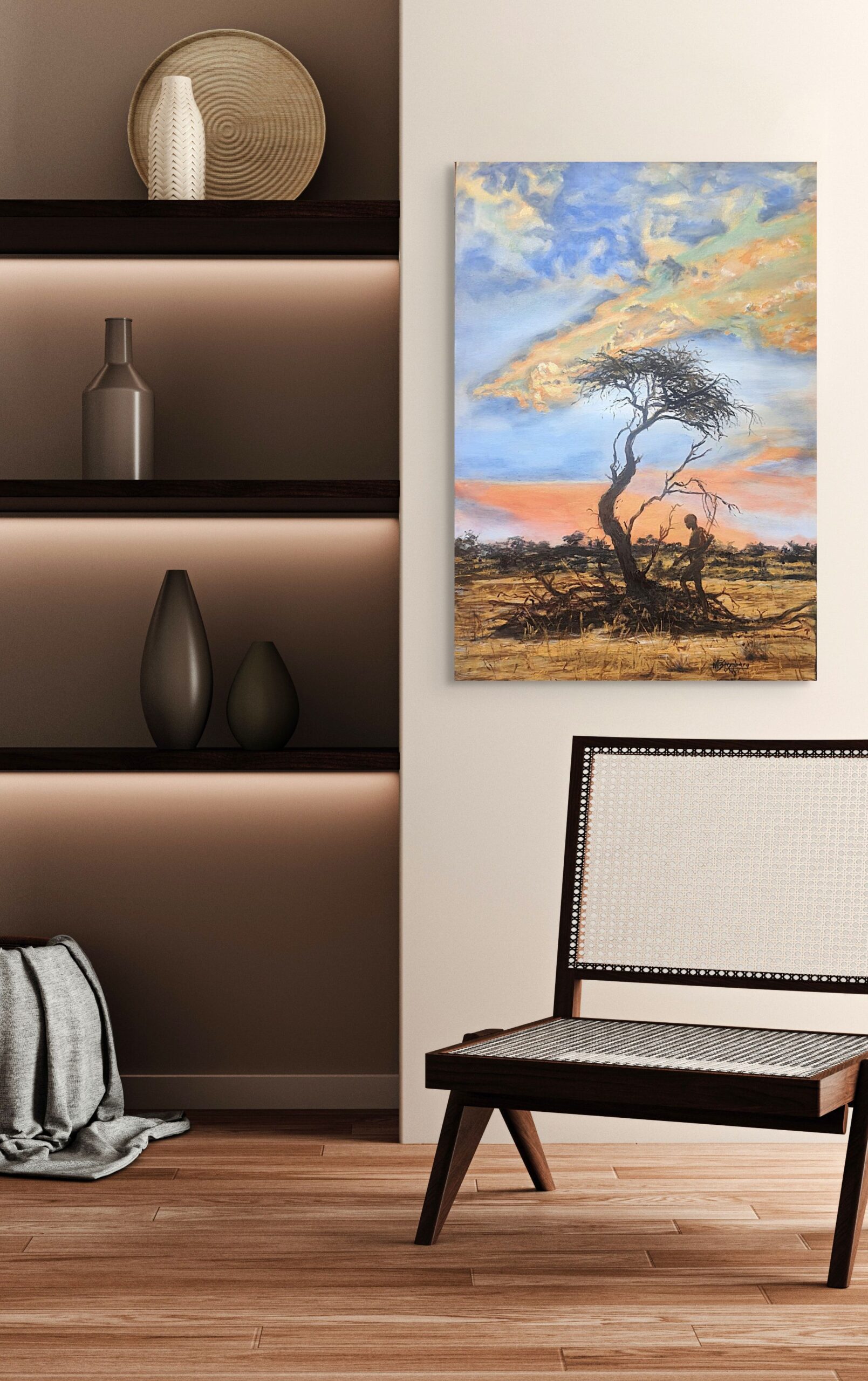
Kalahari: Son of the Wind opens itself slowly, almost ceremonially, as though inviting the viewer to step into a world where myth and daily life merge with a natural ease that defines Marika Steynberg van Wyk’s artistic voice. Here, the Kalahari is not a backdrop but a living presence, breathing through immense skies and shimmering horizons. The scene centres on a young Bushman boy poised beside a twisted tree, his small figure anchored in a landscape that feels both ancient and intimate. The painting carries within it the resonance of stories told around fires at dusk, where wisdom travels lightly on the desert air and the boundary between the human and the elemental becomes wonderfully porous.
The Wisdom of the Sands: A Note from the Artist
Marika’s work is deeply informed by her personal dialogues with Bushman leaders, revealing a culture where humanity and nature exist in “cosmic unity” rather than hierarchy. Central to this piece is the legend of the Son of the Wind, a narrative that transcends mere storytelling to offer a vital ecological lesson. It teaches that to truly belong to the land, one must learn to “see with eyes from above”, observing with wisdom, hunting without havoc, and waiting without hatred. For Marika, the eagle is a spiritual bridge to the heavens, a “hunter of the sky” whose presence reminds us that we are stewards of a sacred, interconnected chain of life. Through this lens, the Bushman’s ancient stories are not relics of the past, but enduring blueprints for a respectful and sustainable future.
Marika’s palette creates an atmosphere that feels almost otherworldly. Soft blues drift into delicate peach and molten gold, the colours blending with such quiet harmony that the sky seems to move even as one watch. These hues echo the Bushman imagination in which wind, cloud and creature speak in a shared, symbolic language. The warm earth tones of the foreground counterbalance the celestial expanse, grounding the viewer in the tangible world of dust, roots and grass. Marika’s layering of pigment creates a luminous quality, a gentle radiance that situates the boy in a moment of awakening or remembrance, as though he is listening for something older than himself.
Her brushwork guides the gaze with deliberate sensitivity. The tree, gnarled and wind-shaped, becomes both a physical structure and a metaphorical spine, directing attention to the boy’s delicate silhouette. The branches reach out like gestures of an unseen storyteller, echoing the oral traditions that have defined Bushman culture for countless generations. These stories speak of deep kinship with the earth, of a worldview shaped not by dominance but by belonging. Within this composition, that philosophy breathes quietly; the boy appears not as an intruder upon the land but as an extension of its rhythm.
The painting gently evokes the legend of the eagle and the son of the wind, a tale in which a young Bushman learns from a great eagle how to see with clarity, wait with patience and act with ecological reverence. Marika captures not the narrative itself but its emotional spine, its sense of spiritual mentorship and the sacred bond between humans and nature. The vastness of the sky suggests the eagle’s domain, while the boy’s upward posture carries the vulnerability and yearning of someone who seeks meaning beyond the visible world. Through this interplay, the artwork gestures toward themes that echo across humanity: the search for guidance, the desire for freedom, the longing to understand one’s place within creation.
The composition’s quietness is deceptively powerful. Silence here is not emptiness; it is a form of listening. The viewer is invited into that silence, encouraged to sense the pulse of the desert, the stirring of wind through thorn branches, and the presence of wisdom passed from one generation to the next. In this way, the artwork becomes a reflection on ecological responsibility, reminding us that the earth does not merely hold life; it teaches, shelters and mirrors the consciousness of those who walk gently upon it.
What, then, might we learn when we stand beneath a sky like this and allow its stories to reach us? Each viewer may arrive at their own understanding, guided by the quiet invitation of the boy, the tree and the wind that threads them together.
Artist: Marika Steynberg van Wyk