
Description
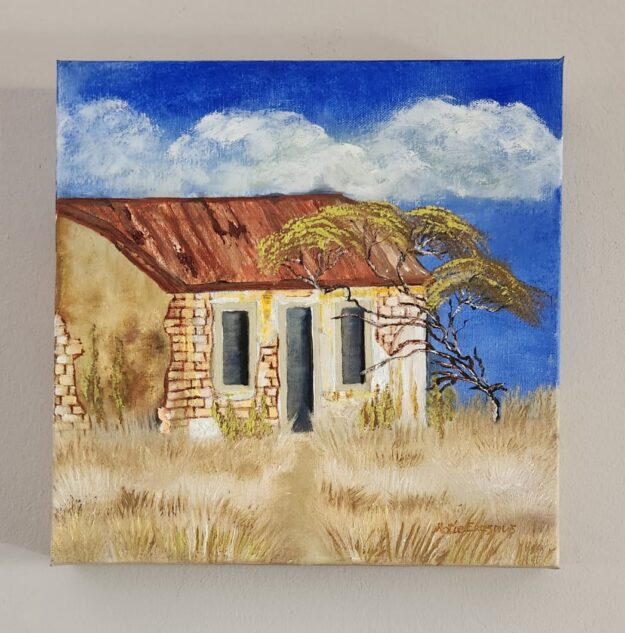
Forgotten times carries an undercurrent of longing; its palette steeped in the language of absence and presence. In this intimate square study, the artist invites us to confront the poignant beauty of decay, focusing our attention on a solitary, crumbling structure that serves as a silent witness to a bygone era in the Namibian hinterland. As a curator, I find myself captivated by how this work transcends its modest scale to evoke a profound sense of history and the inevitable passage of time within a landscape defined by its vast, unforgiving scale. The building, with its exposed sun-baked brickwork and rusted corrugated roof, is not merely a ruin; it is a vessel for the stories of the pioneers and families who once carved a life out of this arid earth, now surrendered to the slow, rhythmic reclamation of the desert.
The emotional resonance of the piece is found in its delicate balance of melancholy and warmth, a feeling that mirrors the bittersweet nature of nostalgia. There is a palpable solitude here, yet it is softened by the vibrant, almost defiant life of the windswept tree leaning against the structure and the sun-scorched grasses that surge toward the foreground. This interaction creates a psychological space where the viewer might feel a gentle unease regarding the transience of human endeavour in such a powerful environment yet find comfort in the enduring cycles of the earth. The dark, hollowed-out windows and doorway act as thresholds to the unknown, prompting us to fill the emptiness with our own imaginings of the lives that once pulsed within these walls, sheltered from the fierce Namibian sun.
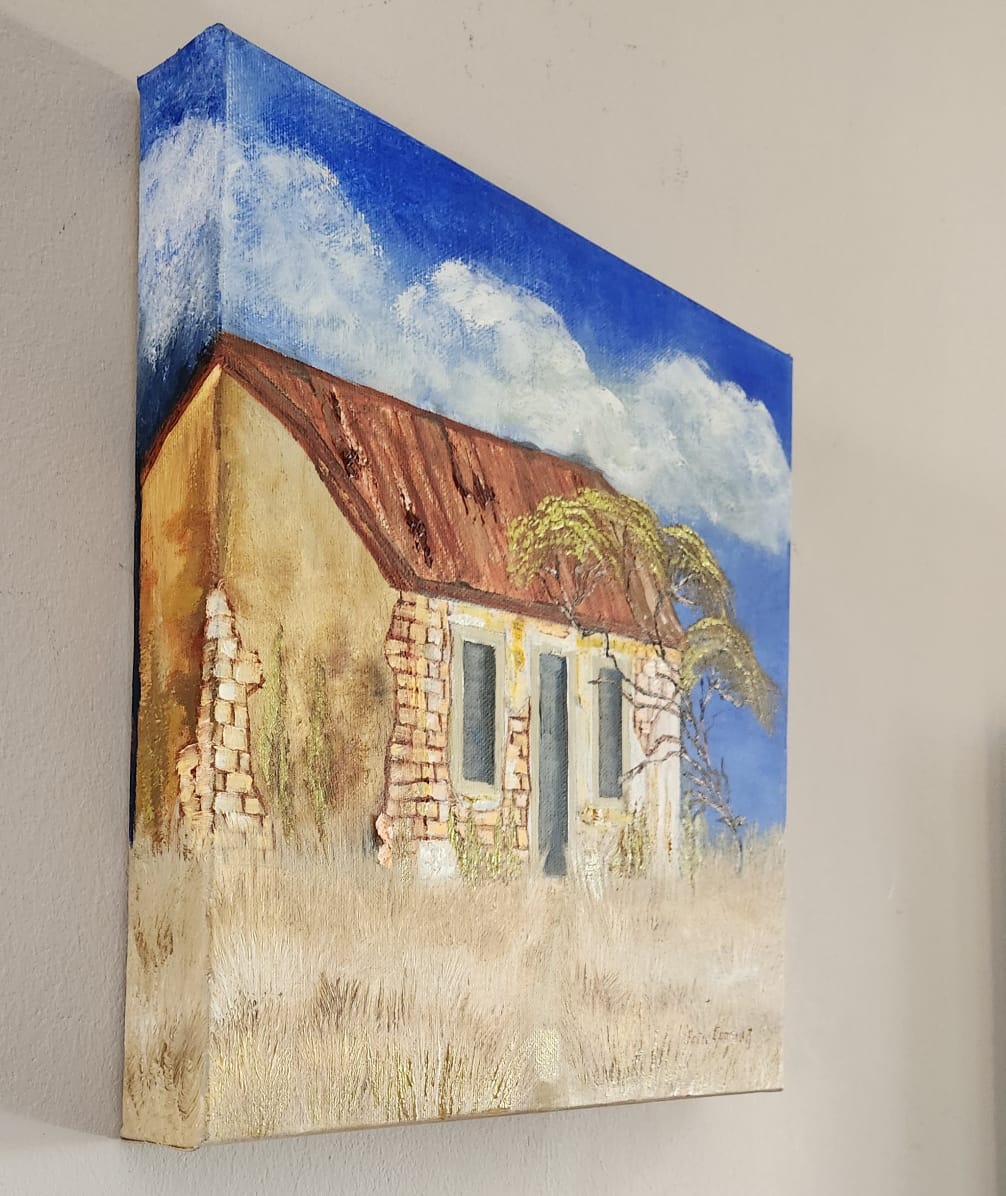
Technically, Katie employs a sophisticated interplay of texture and colour to breathe life into the scene. The roof is a masterclass in the use of burnt sienna and raw umber, layered to suggest the tactile, flaking quality of oxidised metal that has endured decades of desert heat. This warmth is set against a sky of startling, saturated cobalt, a choice that creates a bold dissonance and heightens the emotional tempo of the work, reflecting the intense clarity of the atmosphere often found in the Southwest. The clouds are rendered with a thick, impasto-like application, their creamy whiteness providing a soft counterpoint to the jagged edges of the masonry. Notice how the light seems to catch the tips of the dry grass, achieved through fine, rhythmic brushstrokes that suggest the constant, invisible movement of the breeze across the plains.
The compositional methods are deceptively simple yet highly effective in directing the eye. The central placement of the house provides a strong anchor, while the diagonal line of the roof and the leaning posture of the tree create a sense of dynamic tension that prevents the image from feeling static. The artist uses negative space within the vast sky to emphasize the isolation of the homestead, making it feel like a small island in a sea of time and sand. This arrangement reflects the common threads of life, where our structures and memories are often dwarfed by the magnitude of the Namibian horizon, yet remain significant markers of our shared existence and our attempts to belong to the land.
In Forgotten times, we are presented with a visual poem about the echoes of humanity that linger in the landscape long after the voices have faded. It is a work that speaks to the collective memory of a land defined by both struggle and breathtaking beauty, capturing a fragment of the Namibian spirit that is both fragile and remarkably assured. Katie has managed to find the extraordinary within the ordinary, turning a derelict corner of the world into a site of profound reflection on what it means to leave a mark upon the earth.
As you gaze into the shadowed depths of those empty windows, what echoes of your own history do you hear whispering through the tall, golden grass of the desert edge?
Artist: Katie Erasmus





Reviews
There are no reviews yet.