Description
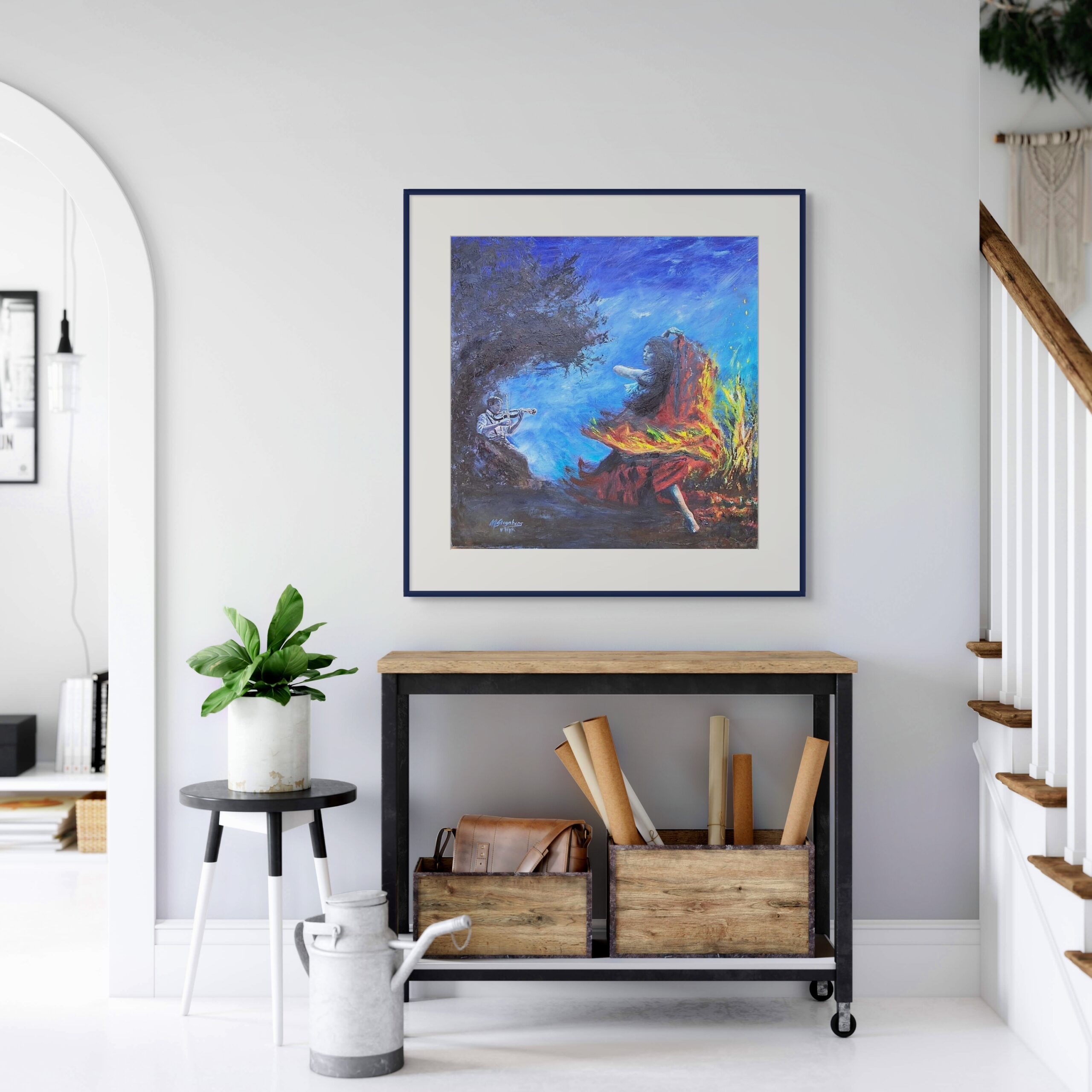
In Gypsy Fire Dance, Marika Steynberg van Wyk explore the intensity of lived experience into a painting that is both personal memory and cultural homage. Inspired by her time camping with the Gypsy people at the Appleby Horse Fair in the United Kingdom during her backpacking travels, this work is her interpretation of a world steeped in tradition, music, and fire-lit celebration. The painting is not a literal record, but an evocation, a distillation of rhythm, colour, and spirit into a single, unforgettable image.
The composition is alive with duality. On the left, a violinist stands in shadow, dressed in white, partially obscured by the dark silhouette of a tree. His presence is quiet yet essential, the source of the music that animates the scene. On the right, a dancer bursts forth in a blaze of red, her dress flowing and transforming into flames. Her body is caught mid-motion, one arm raised, the other extended, her form both human and elemental. Together, musician and dancer create a dialogue of sound and movement, shadow and fire, restraint and abandon.
The painting is charged with passion and intensity. The dancer’s fiery dress is not merely fabric, it is energy, transformation, and liberation. It speaks of the raw vitality of Romani dance, where movement becomes both expression and ritual. The violinist, by contrast, embodies discipline and control, his music the tether that grounds the dancer’s flames. The viewer is drawn into this tension, feeling both the pull of abandon and the anchor of tradition.
The colour palette heightens the drama. The dancer’s red dress dominates, symbolising passion, vitality, and the consuming nature of fire. Red is psychologically powerful, it excites, it energises, it demands attention. Against this, the cool blues and greens of the background create contrast, suggesting night air, mystery, and the surreal atmosphere of a festival camp. The violinist’s white clothing introduces purity and clarity, a counterbalance to the dancer’s intensity. The interplay of warm and cool tones creates a visual rhythm that mirrors the music and movement within the scene.
Marika’s technique is expressive and dynamic. The dancer’s dress is painted with sweeping, flame-like strokes, the brushwork itself becoming part of the dance. The violinist, by contrast, is rendered with more restraint, his form emerging from shadow with subtle precision. The background is loose and atmospheric, allowing the figures to dominate while still suggesting a world beyond the canvas. The use of light is particularly striking: the dancer seems illuminated from within, her flames casting a glow that contrasts with the violinist’s shadowed presence.
Compositionally, the painting is balanced yet charged with movement. The figures are placed in opposition, left and right, shadow and flame, yet the eye is drawn in a circular motion between them, guided by the dancer’s sweeping dress and the implied sound of the violin. The tree on the left acts as a visual anchor, grounding the composition while also deepening the sense of contrast.
At its heart, Gypsy Fire Dance is about culture, memory, and transformation. It honours the Romani people’s traditions of music and dance, while also reflecting Marika’s own journey of discovery during her travels. It is a painting about the power of art, whether through music, movement, or paint, to ignite passion, to preserve heritage, and to connect us across boundaries.
As you stand before Gypsy Fire Dance, you may find yourself asking: What is the fire that moves you? And how do music, memory, and culture ignite the dances of your own life?
Artist: Marika Steynberg van Wyk